Your organization is already telling you what’s wrong.
A confidential Organizational Ombuds hears the signals that never reach leadership, then helps you act on them before friction turns into cost. Especially during growth, integration, and leadership change.

What your organization is telling you
Every organization generates signals. Some are loud.
Most are quiet.
A difficult conversation that never happened. A manager carrying the same issue from team to team. Employees adapting to broken processes instead of reporting them. Friction that becomes accepted as “just how things work.”
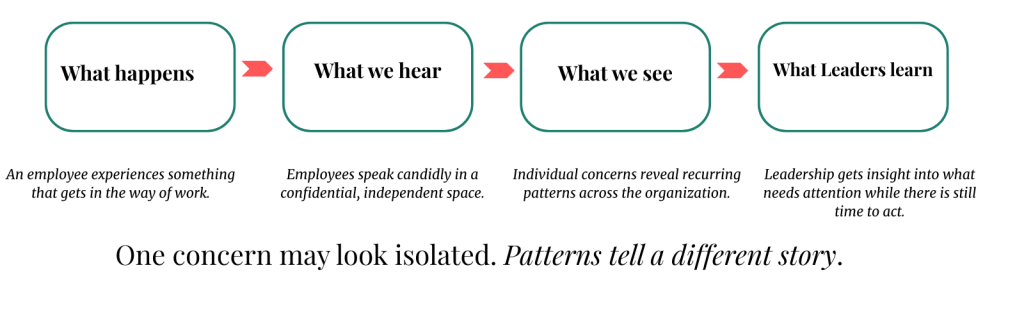
Viewed one at a time, these moments rarely demand attention. Together, they reveal recurring organizational patterns that influence trust, communication, decision making, and performance.
A confidential Organizational Ombuds brings those patterns into focus, giving leaders the clarity to act before isolated concerns become costly organizational problems.
How we help you
An Organizational Ombuds is a confidential, independent, and neutral resource where employees can raise concerns informally. The Ombuds identifies recurring patterns across those conversations and gives leaders insight they can act on, without revealing who said what.

Your Early Warning System
We confidentially hear what’s slowing your teams down, spot the patterns across sites and departments, and give leaders the clarity to fix them early.
Conflict Simulator for Leaders
Talkola is a platform that turns insight into action, helping managers and teams build the skills to raise concerns early, escalate clearly, and keep execution steady as the organization grows.

How the process flows
Why these patterns are easy to miss
Leaders make decisions based on available information
Employee surveys only capture one moment in time
Performance metrics show outcomes
A confidential Organizational Ombuds listens across the organization, connecting experiences that rarely reach the same conversation. That’s how recurring organizational patterns become visible before they affect trust, execution, or growth.
Organizations bring us in when…
Nearly 30 years of hearing what organizations miss

Dina Lynch Eisenberg JD, EMBA, CO-OP
Dina Eisenberg, JD, EMBA, CO-OP, is a Certified Organizational Ombuds, attorney and mediator with nearly 30 years of experience helping organizations surface and resolve workplace friction.
She has served as an Ombuds and trusted advisor to organizations including Bank of America, Coca-Cola Enterprises, St. Jude Children’s Research Hospital and Twitter, where she served as the company’s inaugural Organizational Ombuds.
Dina knows that leaders rarely have the full picture. Employees often see problems first, but concerns can stay buried, get softened as they move up the organization or appear to be isolated incidents.
As founder of Talkola, Dina provides employees with a confidential, independent place to speak candidly. She connects those individual experiences to identify recurring patterns and gives leadership insight into what may be getting in the way of trust, collaboration and getting work done.
The goal is simple: help leaders hear what matters while there is still time to act.
Clarity creates speed. Speed creates value. Value compounds.
Client raves…
Because Dina’s work falls under the umbrella of Ombuds work which is confidential, client identities are not disclosed. The reflections below come from leaders who have worked with Dina during periods of growth, integration, and organizational tension.
- “Dina is incredibly savvy about corporate culture and governance. I highly recommend Dina to any organization seeking a thoughtful, engaging and highly skilled professional who not only understands the big picture but the people within it.
- Matthew Ayres, Generous BrandsSr. VP, General Counsel
- “I was worried the internal friction between our leaders would slow the transaction. Once those conversations happened and decision authority became clear, the entire leadership team moved faster.”
- Alan Siggia, SigmetCEO, co-Founder
Start the Conversation
Every organization develops patterns.
The question is whether leaders recognize them while there is still time to act.
Sometimes those patterns emerge during rapid growth, an acquisition, leadership transition, or operational change. Sometimes they surface in organizations that appear to be performing well but feel increasingly difficult to lead.
If recurring concerns seem disconnected, communication feels strained, or the same issues continue to resurface without resolution, it may be time for a different perspective.
A confidential conversation can help determine whether you’re seeing isolated events or the early signs of a larger organizational pattern.